9 Best Burr Coffee Grinders Under $100 (November 2026)
The best best burr coffee grinders under 100 include the Hamilton Beach Fresh Grind Electric Coffee Grinder for everyday drip coffee, the KRUPS Precision Burr Coffee Grinder for switching between brew methods, and the Ollygrin Burr Coffee Grinder for the widest grind range.
On this page (4 sections)
The best burr coffee grinder under 100 for most homes is the Hamilton Beach Fresh Grind Electric Coffee Grinder. Its removable bowl, dishwasher-safe parts and press-and-hold operation make fresh grounds a two-minute job.
Pick the KRUPS Precision Burr when you switch between French press and espresso, the Ollygrin when you want the most settings, and the CEVING when you grind on the road.
A sub-100 dollars burr grinder is where most home brewers should start. You get more even grounds than a blade grinder, and the step up in cup quality shows up in drip, pour over and French press alike.
The trick is knowing which features matter for your brew method and which are extras you'll never touch.
We compared nine models in this price band on grind settings, burr type, capacity, cleaning and controls. Our score weighs specs, features and buyer feedback against what you're shopping for.
The first pick is the best for most people, and every other model here is the best pick for a named need.
Our picks at a glance
-
1
 Best for everyday drip coffee
Hamilton Beach Fresh Grind Electric Coffee Grinder
9.6/10 our score
See it on Amazon -
2
 Best for switching between brew methods
KRUPS Precision Burr Coffee Grinder
9.4/10 our score
See it on Amazon -
3

- 4
 Best for busy morningsCheck it
- 5
 Check it
CEVING Mini Manual Coffee Grinder
Best for travel and camping - 6
 Check it
SHARDOR Electric Burr Coffee Grinder 2.0
Best for hands-free grinding - 7
 Best for large householdsCheck it
- 8
 Check it
AMZCHEF 48-Setting Burr Grinder
Best for reducing static mess - 9
 Check it
SHARDOR Conical Burr Coffee Bean Grinder
Best for espresso fine-tuning
The best burr coffee grinders under 100 for different brewers
The Hamilton Beach wins overall for its easy daily routine. The rest of the list splits by need: settings for people chasing a specific grind, hands-free timers for big batches, portability for travel and static control for messy counters.
Choose by the job you need done first, then compare the extras.
Hamilton Beach Fresh Grind Electric Coffee Grinder: Best for everyday drip coffee
- Stainless steel blades
- Dishwasher-safe grinding bowl
- Brews up to 12 cups
A low-fuss grinder for anyone who wants fresh grounds without a learning curve. The removable bowl lifts out for filling and pours cleanly.
Pros
- Dishwasher-safe grinding bowl
- Built-in cord storage
- Handles herbs and seeds too
Cons
- Blade grind
- so the particle size is less even than burr models
- No numbered settings
The Hamilton Beach suits anyone who wants fresh grounds without a learning curve. Its stainless steel blades and press-and-release button mean you hold to grind and stop when the texture looks right.
There are no numbered settings to interpret, just your eye and your ear.
The 4.5 oz grinding bowl makes filling easy and pours cleanly into a filter, and it lifts out entirely for washing. It's dishwasher safe, which matters more than it sounds when you grind daily and don't want to hand-scrub oils.
Built-in cord storage under the base keeps the cable out of the way on a small counter, and the body is short enough to sit under most upper cabinets.
It grinds enough for up to 12 cups in one batch, and it also handles peppercorns, fennel and seeds for smoothies. The trade-off is the blade design: the particle size is less even than a burr model, so you get some fines mixed with coarser pieces.
That's a minor issue in drip coffee and a bigger one in espresso.
Buy it for simple everyday drip coffee and for a grinder you can rinse without a fuss. Skip it for espresso if you want a tight, repeatable grind.
KRUPS Precision Burr Coffee Grinder: Best for switching between brew methods
- 12 grind settings
- Flat metallic burrs
- 8 oz hopper
- Auto-stop from 2 to 12 cups
A burr grinder with enough range to move from French press to drip to espresso. The auto-stop measures grounds by cup count so the same batch size is repeatable.
Pros
- 12 grind settings from coarse to fine
- Removable top burr for cleaning
- Auto-stop by cup count
Cons
- Static cling needs a tap before opening
- Best espresso results need the two finest settings
The KRUPS Precision Burr suits the brewer who moves between drip, French press, cold brew and espresso in the same week. Its 12 settings cover coarse to fine, and KRUPS recommends the two finest settings for espresso with freshly roasted beans.
The flat metallic burrs grind evenly, and the auto-stop function stops when the selected quantity from 2 to 12 cups is reached. That cup-count approach makes repeat batches easy without weighing, and the 110-watt motor is sized for home volumes.
The 8 oz hopper holds enough beans for a few days of brewing. The removable top burr and grind chamber simplify cleaning, and a cleaning brush is included.
KRUPS notes that static cling builds up, so tap the lid before opening to keep grounds off the counter. Grinding in smaller amounts also helps consistency and mess.
Against the Ollygrin, this has fewer settings but flat burrs that many brewers find give a more uniform grind. Against the OXO, it costs less and still covers the main brew methods.
Its limitation is the coarse/fine range: 12 settings leave less room to fine-tune a pour over than 30 or 48 settings do, and espresso fans will only have two fine steps to work with.
Buy it if you brew more than one style and want a set-and-forget cup-count timer.
Ollygrin Burr Coffee Grinder: Best for the widest grind range
- 40mm stainless steel conical burrs
- 30 grind settings
- 10 oz hopper
- 2 to 12 cup settings
Offers the most grind choices here, which helps when you want to fine-tune a pour over or chase a coarser French press grind. The slow gear reduction motor keeps heat down.
Pros
- 30 grind settings
- Auto-locking hopper resists spills
- Friction clutch and overheat protection
Cons
- Bulky footprint for a small kitchen
- Slower grinding than flat burr rivals
The Ollygrin offers the widest grind range here. Its 30 settings and 40mm stainless steel conical burrs let you move from an espresso-fine grind to a coarse French press without changing machines.
The slow gear reduction motor produces less friction heat, which keeps flavor and aroma intact.
The 10 oz hopper holds enough beans for several servings. An auto-locking system keeps beans from spilling when you remove the hopper for storage or refilling, which makes transferring beans to the fridge or a jar less of a scramble.
The rotary two-in-one button runs the grinder and the 2 to 12 cup selection, so there's one control to learn rather than a dial and a separate button.
Safety features are a real plus: a friction clutch protects the grinding gear if a small stone sneaks in, and overheating protection guards the motor. The upper burr lifts off for cleaning with the included brush.
Its trade-off against the KRUPS is speed and counter space. The conical burr grinds slower, and the taller 12-inch body takes up more room.
If settings variety is your priority in this price band, it's the pick.
Buy it when you want maximum grind choices for pour over, French press and espresso tuning.
OXO Brew Conical Burr Grinder: Best for busy mornings
- 40mm stainless steel conical burrs
- 15 grind settings plus 43 micro-adjustments
- One-touch start
- 12 oz UV-blocking hopper
The one-touch start remembers your last setting, so the morning routine is a single press. A UV-blocking hopper protects beans in a sunny kitchen.
Pros
- One-touch start remembers last setting
- 43 micro-adjustments for dialing in
- UV-blocking 12 oz hopper
Cons
- The priciest of the top picks here
- Large hopper takes up counter space
The OXO Brew suits a household that grinds at the same time every morning and wants one less decision. Its one-touch start remembers your last setting, so the routine is a single press.
The 15 grind settings plus 43 micro-adjustments let you fine-tune from espresso to French press and cold brew.
The 40mm stainless steel conical burrs produce uniform grounds for even extraction. The large 12 oz removable hopper holds more beans than most models here, and its UV-blocking tint shields beans in sunny kitchens, which helps if your counter faces a window.
A simple dial selects grinding time, and the two-year warranty is the longest on this list alongside the SHARDOR 2.0.
Against the KRUPS and Ollygrin, this has the best controls and the biggest hopper. The cost is the highest score-gap trade-off: it's still under 100, but it's the priciest of the top picks.
The body is also taller than compact models, so measure your counter space under the cabinets.
For a reader who values convenience over setting count, this is the strongest morning-machine option. For someone who likes to tinker with grind size each day, the Ollygrin's 30 settings offer more room.
Buy it for busy mornings and for a hopper that protects beans from light.
CEVING Mini Manual Coffee Grinder: Best for travel and camping
- 40 external grind settings
- Ceramic conical burr
- 30g bean capacity
- Detachable parts
A hand grinder that fits in a bag and needs no outlet. The external adjustment ring changes grind size without opening the body, so stray grounds stay contained.
Pros
- 40 external settings
- Compact and light for travel
- Ceramic burr runs cooler than steel
Cons
- 30g capacity means grinding in batches for a full pot
- Hand cranking takes longer than electric
The CEVING Mini is for travel, camping and small kitchens where an electric grinder doesn't fit. It weighs about 325g and measures 6.7 by 2.3 by 7.4 inches, so it slips into a bag next to a pour over cone.
The manual crank needs no outlet.
Its 40 external grind settings are adjusted from the outside, so you don't open the body and scatter grounds. The ceramic conical burr generates less heat than steel, which helps preserve the bean's flavor.
A 30g capacity suits one or two cups per fill, and the three main parts come apart for cleaning.
Against the electric models, the trade-off is time and batch size. Grinding enough for a full 12-cup pot means several fills and a few minutes of cranking.
Cleaning is also dry-only: CEVING advises against water, so use the included brush or a dry cloth. The ceramic burr is also more brittle than steel if it's dropped on a campsite rock.
For a daily full pot, an electric model here is faster. For a small batch on a campsite or in a hotel room, this is the practical pick.
Buy it for portable brewing and for small, single-serve batches. Skip it if you grind a pot every morning.
SHARDOR Electric Burr Coffee Grinder 2.0: Best for hands-free grinding
- Metallic flat burrs
- 16 precise settings
- 2 to 14 cup auto-stop
- Safety interlock
The auto-stop timer and dual safety lock make this a set-and-forget option for larger batches. A removable chamber with an anti-spill lid keeps the counter cleaner.
Pros
- 16 settings from espresso to French press
- 2 to 14 cup auto-stop
- Dual safety interlock
Cons
- Larger counter footprint
- Glossy black finish shows smudges
The SHARDOR 2.0 suits people who grind larger batches and would rather not stand over the machine. Its smart timer dial selects 2 to 14 cups and runs hands-free, stopping on its own when the batch is done.
The dual safety interlock means it only runs when the hopper and chamber are locked.
The metallic flat burrs and 16 settings cover espresso-fine to French press-coarse. A removable chamber with an anti-spill lid helps control scattering, and a two-in-one cleaning brush and spoon come in the box.
The 8.5 oz hopper is a sensible size for a two-person kitchen, and the 150-watt motor handles daily use.
Against the KRUPS and Ollygrin, this has fewer settings than the Ollygrin but more cup-count flexibility, and a larger footprint than the KRUPS. The auto-stop by cup count and the safety lock make it the easiest for big-batch drip brewers.
The glossy black finish shows smudges, so keep a cloth nearby.
If you make a full pot most mornings and want to walk away while it grinds, this is the pick. If you mostly pull single shots or brew one cup, the smaller KRUPS or Ollygrin fit better.
Buy it for hands-free full-pot grinding and for the safety lock that keeps kids and spills in check.
Cuisinart Supreme Grind DBM-8: Best for large households
- Stainless steel flat burrs
- 18 grind levels
- 4 to 18 cup slide dial
- Removable 8 oz hopper
A long-running flat burr model with an 18-position selector and a slide dial for up to 18 cups. The grind chamber holds enough for 32 cups, so it suits big-batch brewers.
Pros
- 18 grind levels from espresso to cold brew
- Slide dial for 4 to 18 cups
- Brushed stainless housing
Cons
- Taller cabinet than compact models
- Older design with fewer micro-adjustments
The Cuisinart Supreme Grind DBM-8 is for the household that brews big pots and wants one grinder to keep up. Its 18 grind levels span ultra-fine for espresso to extra-coarse for French press and cold brew.
The slide dial selects 4 to 18 cups worth of grounds with automatic shutoff when the cycle ends.
The grind chamber holds enough ground coffee for up to 32 cups, so a dinner party or a week of cold brew is a single run. Stainless steel flat burrs crush rather than chop beans for a more uniform particle size, and the 140-watt heavy-duty motor is built for daily use.
The removable 8 oz hopper and chamber lift out for emptying, and top-rack dishwasher-safe parts make cleanup simple. A cleaning brush, scoop and cord storage are included.
Against the newer models here, this is an older design with fewer micro-adjustments and a taller cabinet at 12.25 inches. But it's a workhorse for volume, and the brushed stainless housing looks the part on a counter.
If you brew 12 or more cups at a time and want the fewest refills, this is the pick. If you mostly make a cup or two, its bulk is more than you need.
Buy it for large households and big-batch brewing.
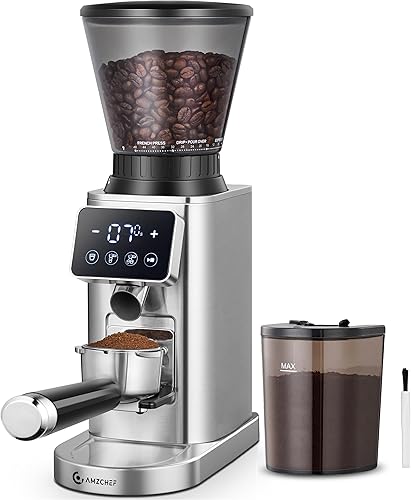
AMZCHEF 48-Setting Burr Grinder: Best for reducing static mess
- 48 grind settings
- 40mm stainless steel conical burrs
- Anti-static technology
- Touchscreen timer
Anti-static technology and a stainless steel container cut down on grounds clinging and scattering. The touchscreen timer gives precise control up to 40 seconds.
Pros
- 48 grind settings
- Anti-static design
- 0.5s timer accuracy and manual mode
Cons
- Pricier than simpler burr models
- Touchscreen can be fussy with wet fingers
The AMZCHEF 48-Setting grinder suits people bothered by static cling and messy counters. Its built-in anti-static technology and stainless steel container help grounds flow out cleanly into a filter or brewer.
The 48 settings and 40mm conical burrs cover fine espresso to coarse French press.
The smart touchscreen selects 2 to 12 cups and sets grind time up to 40 seconds with 0.5-second accuracy. A manual mode lets you start and stop on demand.
The 10.6 oz hopper has a UV-blocking tint and a trap door to prevent spills when you remove it. The 150-watt motor runs on 120 volts.
The holder is designed to sit a portafilter under the chute, with pads for 51 mm baskets and direct fit for 54 mm and 58 mm. An E3 error code means the hopper isn't locked, so rotate it clockwise until it clicks.
Against the Ollygrin and KRUPS, this costs more and its touchscreen can be fussy if your fingers are wet from rinsing a filter. But the anti-static design is a real comfort upgrade for a kitchen where grounds end up everywhere.
Buy it for a cleaner counter and for precise, touchscreen-controlled grinding.
SHARDOR Conical Burr Coffee Bean Grinder: Best for espresso fine-tuning
- 48 grind settings
- Conical burr at low speed
- Anti-static
- 9.7 oz locking hopper
A conical burr model with 48 settings and a precision timer that adjusts in 1-second steps. The anti-static chamber helps grounds flow out cleanly.
Pros
- 48 settings for espresso to French press
- Precision timer up to 40 seconds
- Anti-static chamber
Cons
- Prone to overheating on long back-to-back runs
- Touchscreen needs a light touch
The SHARDOR Conical Burr grinder suits espresso-focused brewers who want to dial in a fine grind. Its 48 settings and conical burr run at low speed to limit heat and help release the oils for flavor.
The anti-static chamber keeps grounds from sticking and flowing messily.
The precision timer adjusts in 1-second steps up to 40 seconds on a clear LCD touchscreen. The 9.7 oz hopper has a locking system for safe operation.
Detachable parts make cleaning simpler, and the touchscreen shows error codes for common issues, so a stalled grind is easier to diagnose than on a dial model.
Against the AMZCHEF and Ollygrin, it's a close call on settings and static control. The key trade-off is endurance on long runs: back-to-back grinding can trigger the overheat protection, and the screen shows E1 until the machine cools for about 10 minutes.
The touchscreen also needs a light, deliberate press.
If you mostly pull espresso shots and want fine control without spending more, this is a solid pick. For bigger daily batches, the auto-stop models here are more comfortable.
Buy it for espresso fine-tuning and for an anti-static chamber that pours clean.
How we compared these burr grinders
We checked the specs on each model in this price band and scored them against the needs of a typical home brewer. The key factors were burr type and grind range, capacity, cleaning, controls and how well each fits a specific brew method.
Burr type came first. Flat and conical burrs both crush beans more evenly than blades.
Within that, flat burrs often give a more uniform grind, while conical burrs run cooler and quieter. For espresso, we favored models with fine settings and a timer.
For drip and cold brew, we favored capacity and auto-stop. A grinder that only reaches medium-fine won't pull a good shot no matter how you tamp.
Then we weighed daily use. Removable, washable parts and anti-static features save time and mess.
Cup-count timers make repeat batches easy. A hopper that blocks light keeps beans fresher.
We also noted the small frictions that show up over time: a touchscreen that fights wet fingers, a body that shows smudges, a hopper that needs two hands to lift.
Our score weighs specs, features and buyer feedback against what you're shopping for. That's why the Hamilton Beach, with its simple blade design and easy cleaning, tops the list for most people, while the burr models rank by how many brew methods they handle well.
What should you look for in a burr coffee grinder under 100?
Start with the grind range your brew method needs, then pick the controls and cleaning you'll actually use. A wide setting range matters most for espresso and pour over, while capacity and a timer matter most for drip and cold brew.
How many grind settings do you need?
Twelve settings cover the main brew methods: coarse for French press, medium for drip and fine for espresso. If you brew pour over or espresso often and want to adjust by small steps, 30 to 48 settings give more room to dial in.
More settings don't make a grinder better on their own, but they help when you're chasing a specific taste or a new bag of beans that wants a slightly different grind.
Flat burrs or conical burrs?
Flat burrs often produce a more uniform grind, which suits espresso and pour over. Conical burrs run at lower speed and generate less heat, which helps preserve aroma.
Neither type is strictly better. Pick by the grind range and settings first, then let burr type guide the final choice.
In this price band, the difference between two well-built burr grinders is smaller than the difference between either one and a blade grinder.
How much capacity do you need?
Match hopper size to your brewing volume. A 4 to 8 oz hopper suits one or two people making a daily pot.
A 10 to 12 oz hopper means fewer refills for a household that brews several pots. For travel or single cups, a 30g hand grinder is enough.
Remember that hopper size is bean storage, not grounds output: the Cuisinart's chamber holds grounds for up to 32 cups even though its hopper is only 8 oz.
Is cleaning easy on these grinders?
Look for removable burrs and a lift-out chamber. A dishwasher-safe bowl, like the Hamilton Beach's, is the easiest to live with.
Static cling is the usual mess source, so an anti-static chamber or a tap-before-opening habit helps. Brush out oils weekly and let washable parts dry fully.
Should you buy a manual or electric grinder?
Choose electric for daily full pots and manual for travel or small batches. An electric model saves time and effort, while a hand grinder like the CEVING gives burr consistency without an outlet.
Many households keep both: an electric for mornings and a manual for trips. Our best compact burr coffee grinder roundup covers small electrics for tight counters.
Does grind size matter for moka pot and cold brew?
Yes, and both need specific settings. Moka pot coffee wants a fine-to-medium grind, while cold brew wants coarse.
A grinder with a wide range covers both. Our guide to the coffee grinder for moka pot explains the grind and dose in more depth.
Which burr grinder under 100 should you buy?
The best burr coffee grinder under 100 for most homes is the Hamilton Beach Fresh Grind, because its easy cleaning and simple operation make fresh grounds part of the daily routine. Pick the KRUPS Precision Burr if you switch brew methods often, the Ollygrin for the most settings, the OXO for one-touch mornings, the CEVING for travel and the SHARDOR 2.0 for hands-free full pots.
For big-batch brewing, the Cuisinart Supreme Grind holds the most grounds. For static control and espresso tuning, the AMZCHEF and SHARDOR Conical are the close contenders.
Our top 3 picks at a glance
-
1
Best for everyday drip coffee
Hamilton Beach Fresh Grind Electric Coffee Grinder
9.6/10 our score
See it on Amazon -
2
Best for switching between brew methods
KRUPS Precision Burr Coffee Grinder
9.4/10 our score
See it on Amazon -
3
Frequently asked questions
Is a burr grinder under 100 dollars better than a blade grinder?
Yes for consistency. A burr grinder crushes beans to a more even particle size, so extraction is more uniform.
A blade grinder chops and leaves a mix of fines and chunks.
The Hamilton Beach here is a blade model, so choose a burr model if even grounds matter most to you.
Can a budget burr grinder handle espresso?
Some can get close. Models with fine settings like the KRUPS, Ollygrin and both SHARDOR grinders reach espresso territory.
The finest setting on an entry burr grinder often lands in the espresso range rather than a true Turkish powder.
Dial in by taste and shot time.
How often should I clean a burr coffee grinder?
Clean the removable burr and chamber every week or two for daily use. A quick brush out after each session keeps oils from building up.
Wash only the parts the maker says are washable, and let them dry fully before reassembling.
Do I need a burr grinder for cold brew?
A coarse setting on a burr grinder works well for cold brew. The even particles steep more predictably than blade-chopped grounds.
Our guide to the coffee grinder for cold brew covers grind size and steep times in more depth.
Can a manual burr grinder replace an electric one?
For small batches, yes. A hand grinder like the CEVING gives you burr consistency without an outlet.
For daily full pots, an electric model saves time.
See our roundup of the best manual coffee grinders for hand-grinding picks.


