9 Best Hand Coffee Grinders for Pour Over (November 2026)
The best hand coffee grinders for pour over include the TIMEMORE Chestnut C3S Manual Coffee Grinderwith Stainless for most pour-over brewers, the QIYUEXES Manual Coffee Grinder 48 Adjustable Settings for grinding larger batches, and the KINGrinder K6 for repeatable settings.
On this page (6 sections)
The best hand coffee grinder for pour over for most brewers is the TIMEMORE Chestnut C3S, with a stepless dial that lets you fine-tune a medium grind cup after cup. Pick the QIYUEXES if you grind for several cups at once, the KINGrinder K6 if you like recording a setting and returning to it, or the 1Zpresso J if pour over is essentially all you brew.
Pour over rewards a grinder that holds a steady medium setting. You want even particles so water flows through the bed at a predictable rate, and a dial you can nudge in small steps as beans age or a recipe changes.
This guide compares hand grinders by burr, adjustment and capacity, then explains how those specs affect a pour-over brew. If you're new to the crank, start with our guide on how to use a manual coffee grinder before you buy.
Our picks at a glance
-
1
 Best for most pour-over brewers
TIMEMORE Chestnut C3S Manual Coffee Grinderwith Stainless
9.5/10 our score
See it on Amazon -
2
 Best for grinding larger batches
QIYUEXES Manual Coffee Grinder 48 Adjustable Settings
9.3/10 our score
See it on Amazon -
3

- 4
 Check it
NewlukPro M6 Manual Coffee Grinder for Espresso
Best all-metal build on a budget - 5
 Best for low-fines pour overCheck it
- 6
 Check it
JavaPresse Manual Stainless Steel Coffee Grinder
Best low-cost starter grinder - 7
 Best for espresso and pour over in oneCheck it
- 8
 Check it
YQE Mini Manual Coffee Grinder
Best for travel and camping - 9
 Best for pour-over specialistsCheck it
The best hand coffee grinders for pour over
The TIMEMORE C3S tops the list for medium-grind pour over, while each other pick is the best answer for a named need. Burr type and adjustment style matter more than extra features for filter brewing.
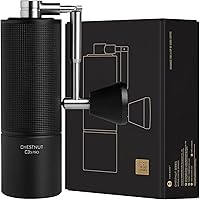
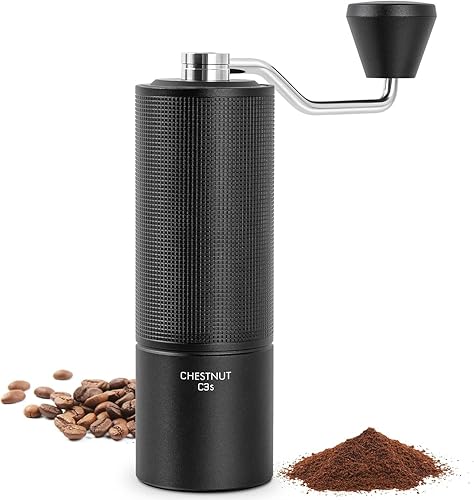
TIMEMORE Chestnut C3S Manual Coffee Grinderwith Stainless: Best for most pour-over brewers
- Patent S2C steel conical burr
- Stepless grind adjustment
- All-metal aluminum alloy body
- 25 g capacity
A steel S2C burr and stepless dial make medium pour-over grinds easy to fine-tune. The all-metal body keeps it sturdy without making it heavy.
Pros
- Stepless dial for medium-setting tweaks
- Dual-bearing design
- All-metal body with no plastic inside
Cons
- 25 g capacity is small for two large mugs
- Not meant to be washed with water
The C3S suits a brewer who wants one grinder that handles the daily pour over without fuss. Its stepless adjustment means you move the dial smoothly rather than counting clicks, so small changes to a medium setting are quick.
The S2C steel burr is the heart of it. TIMEMORE says the burr cuts beans into consistently sized particles, and that's exactly what a pour-over bed needs so water passes through evenly.
Steel also cuts faster than ceramic, which keeps a single dose under a minute of cranking.
At 530 g with a 25 g hopper, it holds enough for one or two mugs. The all-metal aluminum alloy body has no plastic parts inside, and the dual-bearing design on the central axis is meant to keep the grind uniform and the setting steady over time.
A 52 mm frame is easy to grip, and the brush handles cleaning, since water isn't recommended for the body or burr.
Skip it if you regularly grind for four cups at once. For those mornings, the QIYUEXES below is the better fit.
QIYUEXES Manual Coffee Grinder 48 Adjustable Settings: Best for grinding larger batches
- 48 numbered grind settings
- 80 g bean capacity
- Conical ceramic burr
- Two jars included
The 80 g hopper and two jars suit brewers grinding for several cups or a household. Numbered settings take the guesswork out of returning to a medium grind.
Pros
- Large 80 g capacity
- Two jars plus brush included
- Three-piece body comes apart easily
Cons
- Ceramic burr is slower than steel at medium grinds
- Plastic parts in the build
The QIYUEXES suits anyone who grinds a big dose in one go. Its 80 g capacity is the largest here, and the two included jars let you store grounded coffee or split a batch between brewers.
A numbered dial with 48 settings is easy to read and return to. For pour over, that means finding your medium number once and repeating it without guessing.
The ceramic conical burr grinds evenly, but it's slower than steel, so expect more turns per dose.
The frame weighs 425 g and measures 2.95 x 2.95 x 7.28 inches, so it's portable even with the big hopper. The three-piece body comes apart without tools, and a brush is included for upkeep.
It's a practical travel or camping grinder too, though the extra height makes it longer than the mini picks.
Choose it if batch size comes first. Skip it if you want the fastest grind for a single cup, where a steel burr saves time.
KINGrinder K6: Best for repeatable settings
- 16 microns per click
- 60 clicks per rotation
- Stainless steel burr set
- 25-35 g hopper
Click-based adjustment lets you write down a pour-over setting and return to it exactly. The stainless burr set and full aluminum body are built for steady daily use.
Pros
- 16 micron clicks you can record
- External adjustment nut
- Dismantles by hand for cleaning
Cons
- Heaviest pick here at 630 g
- Click counting takes practice at first
The KINGrinder K6 suits a brewer who likes numbers. Each click moves about 16 microns, with 60 clicks per rotation and up to 4 rotations, so you can write down a pour-over setting and land back on it precisely.
The adjustment nut sits on the outside, so you don't open the grinder to change grind. The stainless steel burr set and aluminum body are built for daily use, and the 25-35 g hopper covers one or two cups.
A seven-sided burr geometry is what KINGrinder credits for its consistency.
At 630 g it's the heaviest pick in this guide, and the click counting takes a week or two to feel natural. Once it does, repeatability is its strength, which matters when you change beans and need to move the grind in known steps.
Our full KINGrinder K6 review covers the burr and adjustment in more depth.
Skip it if you'd rather twist a smooth dial and judge by feel. The C3S is the simpler option for that.
NewlukPro M6 Manual Coffee Grinder for Espresso: Best all-metal build on a budget
- SUS 420 38 mm hexagonal core
- Double bearing axis
- Bottom adjustment dial
- 25 g capacity
An all-metal body and steel core at a modest tier suit brewers who want steel burrs without spending more. The bottom dial stays put while you crank.
Pros
- No plastic parts
- Adjustment dial at the bottom
- Comes apart without tools
Cons
- Only 25 g capacity
- Small size suits one or two cups at a time
The NewlukPro M6 suits a brewer who wants steel burrs and an all-metal build at a lower tier. Its SUS 420 38 mm hexagonal core and double bearing axis are the kind of internals usually found on pricier grinders.
NewlukPro says the hexagonal shape grips beans for a more efficient cut and a more uniform particle size.
The adjustment dial sits at the bottom of the burr assembly. That placement keeps your setting from shifting as you crank, which helps when you're chasing a steady medium grind for pour over.
It's small, about the size of a 500 ml water bottle at 2.13 x 2.13 x 6.1 inches, with a 25 g capacity. The body comes apart without tools, and a brush is included for cleaning.
A 1.3 lb weight still feels solid in the hand.
The trade-off is dose size. For one or two cups it's fine; for a full carafe, look at the QIYUEXES.
Skip it if you grind big batches in the morning.
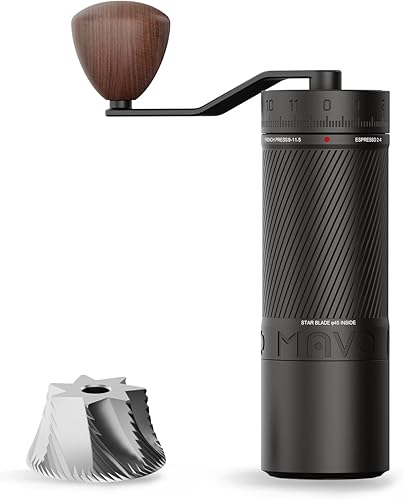
MAVO Manual Coffee Grinder: Best for low-fines pour over
- 45 mm star-tooth burr
- 120 clicks per rotation
- Three-bearing shaft
- 30 g capacity
MAVO says its spiked burr design cuts down on fine powder, which keeps pour-over drawdowns closer to plan. The 120-click dial gives very small steps for dialing in.
Pros
- Fine 0.0167 mm steps per click
- 30 g capacity
- Storage bag and brush included
Cons
- Heaviest grinder in this guide at 1.02 kg
- Adjustment steps can take longer to learn
The MAVO suits a brewer who wants fewer fines in a pour-over bed. MAVO says the spiked star-tooth burr punctures beans with less rubbing between them, which cuts the fine powder that slows a filter.
The dial offers 120 clicks per rotation at 0.0167 mm per click. That's a very fine pitch, so you can adjust a medium grind in tiny moves if a brew runs too slow or too fast.
The 45 mm burr has a 40 percent larger effective grinding size than the brand's earlier design, according to MAVO.
A three-bearing central shaft is meant to keep the burr aligned and the particles homogeneous. The 30 g capacity covers two cups, and a bag and brush are included for storage and cleaning.
A non-slip ring helps you keep a grip while cranking.
Its trade-off is weight. At 1.02 kg it's the heaviest grinder here, which suits a kitchen counter more than a backpack.
Skip it if you want a light travel grinder.
JavaPresse Manual Stainless Steel Coffee Grinder: Best low-cost starter grinder
- 18 grind settings
- Ceramic conical burr
- No cords or batteries
- Hand crank design
The lightest grinder here at 9.4 oz, with 18 settings that cover medium pours. It suits a first step up from pre-ground coffee or a bag for travel.
Pros
- Very light at 9.4 oz
- Quiet hand crank operation
- Simple 18-setting dial
Cons
- Fewer settings than the picks above
- Ceramic burr grinds more slowly
The JavaPresse suits a first-time buyer stepping up from pre-ground coffee. It's the lightest grinder in this guide at 9.4 oz, so it slips into a bag without weighing you down.
Its ceramic conical burr has 18 grind settings, which covers medium pour over well enough for a beginner. JavaPresse says the ceramic burr is tested through three quality inspections and outlasts comparable steel burrs.
The hand crank runs quietly with no cords or batteries, making it a simple choice for camping or a small kitchen.
Fewer settings than the picks above mean less fine-tuning room. If you find a setting you like on one bean, expect to move a notch or two when you switch to another.
At 1.8 x 1.8 x 7.5 inches it takes up little counter space, and the 9.4 oz weight keeps it stable enough to crank without wobbling.
Choose it as a low-cost entry point or a travel backup. Skip it if you plan to dial in pour over closely, where the C3S or K6 give more control.
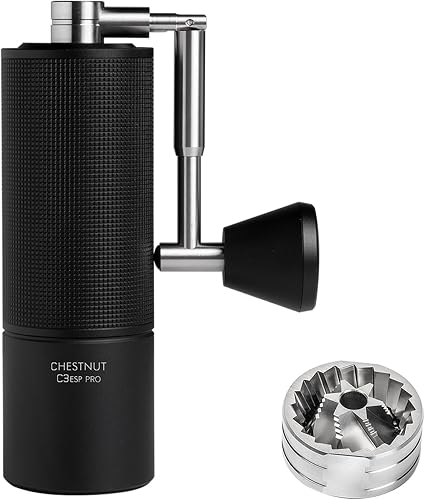
Timemore Chestnut C3 ESP Pro: Best for espresso and pour over in one
- S2C660 stainless steel burr
- 0.0233 mm per click
- Foldable crank handle
- 38 mm burr
A fine adjustment pitch makes this a grinder for brewers who switch between espresso and pour over. TIMEMORE prints circle marks for both methods on the dial.
Pros
- Circle marks for pour over settings
- Folding handle for travel
- Light at 430 g
Cons
- Finer pitch is more than pour over alone needs
- 25 g capacity
The C3 ESP Pro suits a brewer who wants one grinder for espresso and pour over. Its S2C660 stainless burr and 0.0233 mm adjustment steps are fine enough for espresso, while the dial's circle marks make a medium pour-over setting easy to find.
TIMEMORE marks 1.4 to 2.0 circles for pour over and 0.8 to 1.1 circles for espresso, so you're not guessing where each method sits. The folding handle saves space in a cabinet or bag, and the body weighs 430 g.
A built-in bearing keeps the handle turning smoothly, which lightens the cranking.
Capacity is 25 g, which is one or two mugs. If pour over is all you brew, the finer pitch is more than you need, and the C3S is the simpler buy.
The 38 mm burr and all-metal one-piece body are upgrades over the standard C3S frame.
Skip it if you never pull espresso. Choose it if both methods share your counter.
YQE Mini Manual Coffee Grinder: Best for travel and camping
- 40 external grind settings
- Ceramic conical burr
- 30 g capacity
- Stainless steel build
An external ring changes the grind without taking the grinder apart, which helps on a campsite or at a desk. The 30 g hopper makes about two cups.
Pros
- No disassembly to change settings
- Long handle for leverage
- Transparent grounds container
Cons
- Ceramic burr, not steel
- Compact frame is slower for big batches
The YQE Mini suits travel and camping. Its 40 settings adjust from an external ring, so you change grind without taking the grinder apart, which matters on a campsite or at a desk.
The long handle gives extra leverage for smoother grinding and less hand fatigue. The transparent grounds container lets you see how full it's getting and stop before you over-grind.
The conical ceramic burr grinds evenly with less heat than a blade grinder.
At 30 g it makes about two cups, and a brush is included for cleaning the burr. The stainless steel frame resists rust.
The compact 6.7 x 2.3 x 6.7 inch size means more cranking than the larger steel burrs.
Pick it for a bag or a drawer. Skip it if you want fast daily grinding at home, where a bigger steel burr like the K6 or M6 is quicker.
1Zpresso J: Best for pour-over specialists
- 48 mm stainless steel burr
- 30 clicks per rotation
- Foldable crank handle
- 35 g capacity
1Zpresso designs the J around pour over, with 30 clicks per rotation and a 48 mm steel burr. Its folding handle and 35 g hopper suit daily filter brewing.
Pros
- Built with pour over as the main method
- 35 g capacity
- No tools needed to take it apart
Cons
- Fewer clicks per rotation than the K6
- Internal adjustment means opening the top to change grind
The 1Zpresso J suits a brewer whose pour over is the main event. 1Zpresso designed it around filter coffee, with 30 clicks per rotation and a 48 mm stainless steel burr that grinds fast.
The 35 g capacity is the second largest here and covers two or three cups. The folding handle tucks away in seconds, so it stores in a small kitchen or a travel bag without tipping.
1Zpresso factory-calibrates the burr and rates the grinder for 100 to 200 kg of grinding life.
Adjustment sits inside the grinder, which means opening the top to change grind. That's fine if you set it once for pour over and stay there, less convenient if you swap methods often.
Skip it if you want an external dial or finer click counting. Pick it if pour over is all you brew and you want the burr sized for it.
For espresso instead, see our guide to the best hand grinder for espresso.
How these hand grinders compare
| Product | Best for | Burr | Settings | Capacity | Our score |
|---|---|---|---|---|---|
| TIMEMORE Chestnut C3S Manual Coffee Grinderwith Stainless | most pour-over brewers | S2C steel conical | Stepless | 25 g | 9.5 |
| QIYUEXES Manual Coffee Grinder 48 Adjustable Settings | grinding larger batches | Conical ceramic | 48 | 80 g | 9.3 |
| KINGrinder K6 | repeatable settings | Stainless steel | 60 clicks per rotation | 25-35 g | 9.1 |
| NewlukPro M6 Manual Coffee Grinder for Espresso | all-metal build on a budget | SUS 420 hexagonal | Built-in knob | 25 g | 9.1 |
| MAVO Manual Coffee Grinder | low-fines pour over | 45 mm star-tooth stainless | 120 clicks per rotation | 30 g | 8.6 |
| JavaPresse Manual Stainless Steel Coffee Grinder | low-cost starter grinder | Ceramic conical | 18 | 8.3 | |
| Timemore Chestnut C3 ESP Pro | espresso and pour over in one | S2C660 stainless steel, 38 mm | About 36 levels | 25 g | 8.3 |
| YQE Mini Manual Coffee Grinder | travel and camping | Conical ceramic | 40 external | 30 g | 8.2 |
| 1Zpresso J | pour-over specialists | 48 mm stainless steel | 30 clicks per rotation | 35 g | 8.1 |
The table lines up burr type, settings and capacity, the three specs that shape a pour-over grind most. Use it to see at a glance whether a pick has enough dose size or the adjustment style you prefer.
Weight is worth a glance too, since it separates the travel picks from the counter models.
How we compared these grinders
We compared specs and features from the product data, then weighed them against what pour-over brewing asks for: a stable medium grind, even particles and a hopper big enough for your usual dose. Our score weighs specs, features and how well the grinder fits that job.
Burr material got the most weight. Steel burrs cut faster and suit a steady medium setting, while ceramic burrs are slower but common at lower tiers.
Adjustment style came next, because stepless dials and click counts each suit a different kind of brewer. Click pitch matters too: 16 microns per click on the K6 and 0.0167 mm on the MAVO let you move in smaller steps than a dial with 18 broad settings.
Capacity decided placement more than quality. A 25 g hopper that makes one or two mugs still scores well if its burr and dial are right, because dose size is a fit issue rather than a flaw.
Build details like a dual-bearing axis or a three-bearing shaft went into the score as signs of grind consistency. A burr's size also counts, since the 45 mm MAVO core and 48 mm 1Zpresso burr present more cutting surface than the smaller 38 mm designs.
We researched these grinders rather than testing them. This is a comparison based on manufacturer specs and published product details, not a lab test.
What should you check before buying a hand grinder for pour over?
Start with the burr and the setting steps, then confirm the hopper holds your usual dose. Those three decide how a grinder behaves in a pour-over brew more than any other spec.
Steel or ceramic burr?
Steel burrs cut faster and hold an edge over years of daily grinding, so they suit anyone brewing every morning. Ceramic burrs are slower and cheaper to make, and they still grind well for medium pours with less heat.
If you want the best pour-over grind for the money, look at a steel burr first. On this list that means the C3S, K6, M6, MAVO, C3 ESP Pro and 1Zpresso J.
Ceramic picks like the QIYUEXES and JavaPresse are the budget and travel choices.
Stepless dial or numbered clicks?
A stepless dial lets you move the grind smoothly and stop wherever a brew tastes right. A numbered or click dial lets you record a setting and return to it exactly, which helps if you switch beans often.
Pick stepless if you adjust by taste and feel. Pick clicks if you like writing down numbers or if you want to grind for more than one method.
The K6's 16 micron clicks and the MAVO's 120-click dial are the most repeatable options here.
How big a dose do you grind?
A 25 to 35 g hopper covers one to two mugs at a time, which suits most pour-over setups. If you brew for a household or grind a full batch at once, the 80 g QIYUEXES saves refilling.
Think about your largest dose, not your usual one. Filling a small hopper twice is fine, but it can be annoying on a busy morning.
Two jars with the QIYUEXES also let you store a batch without transferring it.
Where will you use it most?
A home grinder can be heavier, with a bigger burr that grinds faster. A travel grinder should be light and simple, with a handle that folds or a body that fits a bag.
The JavaPresse at 9.4 oz and the YQE Mini suit travel; the K6 and MAVO are better left on a counter. Decide the main location before you compare weights, because the lightest grinders here also have the least adjustment range.
Which setting should you start with for pour over?
Begin at a medium grind that feels like coarse sand and adjust from there. Every grinder here sets its medium differently, so the starting point shifts with the model even if the beans and recipe don't change.
If the brew drains slowly and tastes bitter, move coarser. If it runs too fast and tastes thin or sour, go finer.
Change one step at a time and keep notes on the C3S dial position or click count.
The C3 ESP Pro makes this easier for beginners, since TIMEMORE marks 1.4 to 2.0 circles as the pour-over range. On the K6, note the click number from zero each time so you can return to it.
On the MAVO, a single click is only 0.0167 mm, so move several clicks at a time until you know how the burr responds.
For a budget route to the same result, our roundup of the budget coffee grinder for pour over shows where to save.
The verdict: the best hand coffee grinder for pour over
The TIMEMORE Chestnut C3S is the best hand coffee grinder for pour over for most people because its stepless dial and S2C steel burr make a steady medium grind easy to hold. The QIYUEXES is the pick when you grind large doses, and the KINGrinder K6 is the one to choose if you want a setting you can write down and repeat.
For travel, pick the JavaPresse or the YQE Mini. For a grinder that covers espresso and pour over together, take the C3 ESP Pro, and for pour-over-first engineering, the 1Zpresso J.
The MAVO and NewlukPro split the middle, with fine click steps and all-metal builds for brewers who want steel without the top tier.
Decide your dose size and adjustment style first, and the right grinder for your pour-over routine comes into focus.
Our top 3 picks at a glance
-
1
Best for most pour-over brewers
TIMEMORE Chestnut C3S Manual Coffee Grinderwith Stainless
9.5/10 our score
See it on Amazon -
2
Best for grinding larger batches
QIYUEXES Manual Coffee Grinder 48 Adjustable Settings
9.3/10 our score
See it on Amazon -
3
Frequently asked questions
What grind setting should I use for pour over?
Start at a medium grind that looks like coarse sand and adjust from there. If the brew drains too slowly and tastes bitter, go coarser; if it drains fast and tastes thin, go finer.
Is a hand grinder better than an electric one for pour over?
A hand grinder gives you more burr quality for the money, and it runs without power. An electric grinder saves effort when you brew several cups a day, but a good manual costs less at the same grind quality.
How much coffee does a hand grinder hold?
Most hand grinders here hold 25 to 35 g, about one or two mugs. The QIYUEXES holds 80 g, which suits people grinding a full batch at once before brewing several cups.
Do I need to wash a hand coffee grinder?
No. Burrs should stay dry, so brush out the grounds and wipe the body with a dry cloth.
Water can rust steel burrs and leave residue that affects the taste of your next brew.
How long does it take to grind coffee by hand for pour over?
Expect 30 seconds to about a minute for a single dose at a medium grind. Steel burrs cut faster than ceramic ones, and larger burrs speed things up further.