How Does a Coffee Grinder Work?
A coffee grinder works by feeding roasted beans into a spinning or turning cutting surface that crushes them into particles. The size of those particles depends on the gap between the burrs or blades, and that gap is what your grind setting changes.
On this page (11 sections)
- What are the main parts of a coffee grinder?
- How does a burr coffee grinder work?
- How does a blade grinder work?
- How does an electric grinder turn beans into grounds?
- How does a hand grinder work without electricity?
- Why does grind size matter so much?
- What do the numbers on the dial actually change?
- Why do burrs beat blades for even grounds?
- How should you care for a grinder so it keeps working?
- What usually goes wrong with a grinder?
- The bottom line on how a coffee grinder works
A coffee grinder works by feeding roasted beans into a spinning or turning cutting surface that crushes them into particles. The size of those particles depends on the gap between the burrs or blades, and that gap is what your grind setting changes.
Freshly ground coffee loses aroma quickly, so grinding right before brewing is the main reason people keep a grinder at home. How a coffee grinder works comes down to a few moving parts and one adjustable gap.
What are the main parts of a coffee grinder?
Every grinder has a hopper or chamber, a grinding surface, an adjustment, and a motor or crank. The hopper holds whole beans and feeds them down by gravity toward the burrs.
The grinding surface is either a pair of burrs or a spinning blade. A burr set has two shaped steel rings, cones, or discs that face each other.
A blade grinder has a single curved blade at the bottom of a cup.
The adjustment changes the gap or the time the beans spend in the cutting zone. A motor, or your hand on a crank, supplies the turning force.
A catch cup or bin collects the grounds at the end.
How does a burr coffee grinder work?
Beans drop between two burrs, and the burrs crush and shear them as the gap narrows. The outer burr or disc stays fixed while the inner one turns, or the lower burr spins under a fixed upper ring.
Whole beans enter at the top, where the gap is wide. As they travel down, the gap gets tighter and the beans are broken into smaller and smaller pieces.
They leave at the bottom as grounds at the size set by the final gap.
The result is fairly even particles because the beans all pass through the same space. A conical set uses cone and ring shapes; here is what a conical burr coffee grinder is and why the cone shape is common in home machines.
How does a blade grinder work?
A blade grinder works by chopping beans with a spinning blade in a closed cup. The longer you run it, the finer the average piece gets.
There's no fixed gap, so size comes from timing and how much coffee is in the cup. A full cup grinds more slowly than a small one because the blade has more beans to reach.
Shaking the grinder while it runs is a common trick to even things out.
The particles come out mixed, from fine dust to larger chunks. That mix suits some brewers but makes espresso hard to repeat.
Blade grinders are cheap and simple, which is why they remain a common first grinder.
How does an electric grinder turn beans into grounds?
The motor spins the burr at a set speed, and the grind setting controls the gap the grounds pass through. You load beans in the hopper, pick a setting, and press a button or switch.
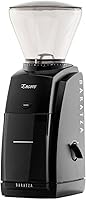
On many machines the dose is timed. The Baratza Encore uses a front-mounted pulse button and an ON/OFF switch, so you hold or press to run the grind.
The Breville Smart Grinder Pro adds a digital timer you can set in 0.2 second increments, which gives an exact dose every time.
Some electric grinders let you grind straight into a portafilter, while others drop grounds into a container. An electric grinder trades counter space and noise for speed and repeatable settings.
How does a hand grinder work without electricity?
You turn a crank, and the force travels through a shaft to the burr while the body stays still. Beans in the top chamber feed into the burr set, and grounds collect in a cup at the bottom.
The 1Zpresso K-Ultra uses stainless steel conical burrs and an external dial with more than 100 clicks at 20 microns each. A magnetic catch cup snaps into place and holds 35 to 40 g of grounds.
Its handle folds away so the grinder packs into a bag or a small kitchen drawer.
Hand grinding is slower than electric grinding, but the slower speed keeps the grounds cooler. The trade-off is effort, especially for espresso-fine settings.
Why does grind size matter so much?
Grind size controls how fast water extracts flavor from the coffee. Finer grounds expose more surface to water and give up flavor faster; coarser grounds slow that down.
That's why each brew method calls for its own range. Espresso needs a fine, even grind to build pressure.
A French press wants coarse grounds that steep and press cleanly. Pour over sits in between.
When the grind doesn't match the method, you taste it. Too fine in a drip brewer can mean a slow drawdown and a bitter cup.
Too coarse in espresso can mean a fast, thin shot. The grinder's job is to hit the right band and stay there.
What do the numbers on the dial actually change?
The dial moves the burr, changing the gap between the grinding surfaces. On the K-Ultra, each click is about 20 microns of movement.
On the Encore, the hopper rotates to one of 40 settings across the full brew range.
More settings mean finer control, not automatically better coffee. The useful question is whether the grinder can repeat a setting you liked.
A click-based dial helps here, because you can return to the same number next time.
Setting numbers don't travel between brands. A "5" on one grinder and a "5" on another can produce very different particles.
Treat the numbers as your own reference points and adjust by taste.
Why do burrs beat blades for even grounds?
Burrs crush beans at a controlled gap, while a blade chops until you stop it. The even particles from burrs let water flow at a steady rate, which makes results easier to repeat.
Even grounds also help you dial in. If most particles are the same size, changing the setting by one click shows up clearly in the cup.
With a blade grinder, the mix of dust and chunks blurs the effect of any change.
This matters most for espresso and pour over, where flow time and extraction are easy to notice. For a French press or a cold brew steep, the difference is smaller.
If you're weighing an upgrade, this guide on whether a burr grinder is worth it walks through the trade-offs.
How should you care for a grinder so it keeps working?
Keep the burrs clean and dry, and empty stale beans from the hopper. Oils from coffee build up on the burrs and can make grounds clump or taste stale.
Brush out the grinding chamber regularly. The K-Ultra dismantles without tools and ships with a cleaning brush and an air blower.
Many electric grinders have removable upper burrs you can lift out for brushing.
Never wash burrs with water; moisture can rust steel and gum up the mechanism. Wipe the hopper and body with a dry or barely damp cloth.
When you learn how to use a burr coffee grinder, cleaning is part of the routine.
What usually goes wrong with a grinder?
Most problems trace back to power, blockage, or a setting that slipped. A grinder that won't start may have a loose plug, a tripped outlet, or a safety switch that isn't seated.
A grinder that runs but produces nothing often has beans stuck in the feed path or a full chute. Stale or oily beans can also jam the burrs.
If your machine stops mid-grind, our checklist on a coffee grinder not working covers what to check first.
Uneven results after months of use often mean worn or dirty burrs. On hand grinders, check that the adjustment ring hasn't shifted.
A quick cleaning and a reset to a known setting solve many complaints before any repair is needed.
The bottom line on how a coffee grinder works
A coffee grinder works by moving beans through a cutting zone and letting the gap at the end set the particle size. Burrs crush at a controlled gap, which gives even grounds and repeatable settings.
A blade chops by time, which is cheap but uneven. For most home brewers, the Encore is the easy electric pick, while the K-Ultra suits anyone who wants precise clicks and portability.
Pick a burr grinder that covers your usual brew method and you'll get the consistent grounds the rest of your gear depends on.
Frequently asked questions
Do burr grinders and blade grinders make the same grounds?
No. Burr grinders crush beans between two shaped surfaces at a set gap, so most particles come out close to the target size.
Blade grinders chop with a spinning blade until you stop, so a single batch holds both dust and chunks.
Does the speed of the grinder change the taste?
It can affect the grounds more than the beans. Fast burrs can warm the coffee, while slower hand cranking and low-speed motors keep the grounds cooler.
Grind size, though, has a bigger effect on how the coffee tastes in the cup.
Why do the same settings give different results on two grinders?
Each grinder counts settings in its own way. One click might move the burrs a few microns, another might move them much more.
Matching numbers across brands means nothing, so dial in by taste and brew time instead.
Can I grind coffee for espresso in a blade grinder?
It's a poor fit. A blade chops unevenly, and espresso needs a narrow band of very fine, even particles to build pressure.
You can try it, but expect sour or bitter shots and a hard time repeating a good result.